
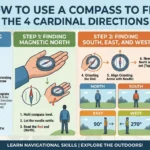




Introduction
Knowing how to find north, south, east and west is a basic navigation skill that can help you understand your surroundings and travel with greater confidence. Whether you are hiking, camping, exploring an unfamiliar location or learning outdoor navigation, a compass provides a simple way to identify directions.
Although smartphones and GPS devices offer convenient navigation, they depend on batteries, signals and working technology. A traditional magnetic compass works differently. Its magnetised needle responds to Earth’s magnetic field, allowing you to identify magnetic north without an internet connection.
However, using a compass correctly requires more than simply looking at the needle. You need to understand its markings, hold it properly and know how the four cardinal directions relate to one another.
In this guide, you will learn how to use a compass to find north, south, east and west, understand basic compass readings, avoid common mistakes and practise simple navigation techniques.
What Are the Four Cardinal Directions?
The four main directions used in navigation are called cardinal directions. They provide a standard way to describe where something is located or which way you are travelling.
These directions are:
- North (N): The direction towards the top of a standard north-up map.
- South (S): The direction directly opposite north.
- East (E): The direction to your right when you face north.
- West (W): The direction to your left when you face north.
You can use these four directions to describe locations, follow routes and understand maps.
For example, if a campsite is east of your current position, you know that you need to travel towards the east to reach it, assuming the route is accessible.
Understanding the Four Directions on a Compass
Most basic compasses display the four cardinal directions around a circular dial.
<escape>
NORTH (N)
|
|
WEST (W) ——–+——– EAST (E)
|
|
SOUTH (S)
</escape>
The four directions are always positioned in the same relationship to one another:
- North is opposite south.
- East is opposite west.
- East is 90 degrees clockwise from north.
- South is 180 degrees from north.
- West is 270 degrees clockwise from north.
This arrangement makes it easier to understand compass readings and identify directions once you know where north is.
Understanding the Main Parts of a Compass
Before learning how to use a compass, become familiar with its basic parts. Although designs vary, many traditional baseplate compasses include the following components.
1. Magnetic Needle
The magnetic needle is the most important part of a basic compass. It rotates freely and aligns with Earth’s magnetic field.
Most outdoor compasses use a coloured or marked end to identify the north-seeking end of the needle. Check the manufacturer’s markings rather than assuming that a particular colour always represents north.
2. Compass Dial or Bezel
The dial is the circular section marked with directions or degrees. It may display N, E, S and W, along with intermediate directions and degree markings.
You can rotate the dial on many navigation compasses to set or read a bearing.
3. Direction-of-Travel Arrow
The direction-of-travel arrow indicates the direction in which you intend to move when following a bearing.
It is particularly useful when working with a map or navigating towards a specific destination.
4. Orienting Arrow
The orienting arrow helps you align the compass dial with the magnetic needle when taking a bearing.
It is sometimes called the compass housing arrow.
5. Baseplate
The baseplate is the flat body of a baseplate compass. It often includes a straight edge, measurement markings and direction-of-travel arrow.
You can use it to measure distances and align your compass with a map.
How to Use a Compass to Find North
Finding north is the first step towards identifying the other three cardinal directions.
Follow these simple steps:
Step 1: Choose an Open Area
Stand in a place where you can hold your compass comfortably and keep it away from nearby magnetic objects.
Metal items, vehicles, electrical equipment and other sources of magnetic interference can affect the needle.
Step 2: Hold the Compass Flat
Place the compass in your open palm or on a level surface.
Keep it horizontal so the magnetic needle can move freely. Avoid tilting or shaking the compass while taking a reading.
Step 3: Allow the Needle to Settle
Wait for the magnetic needle to stop moving.
The north-seeking end will align with the local magnetic field. Identify the end marked as north according to your compass.
Step 4: Identify Magnetic North
Once the needle settles, observe the direction indicated by its north-seeking end.
That direction is magnetic north.
Remember that a magnetic compass does not automatically point to geographic or true north. The difference between these directions is called magnetic declination, which we will explain later.
Step 5: Face the North Direction
Turn your body until you are facing the direction indicated by the north-seeking end of the compass needle.
You have now identified the other cardinal directions using your position.
How to Find South Using a Compass
Finding south is straightforward once you have identified north.
South is directly opposite north, so you do not need to take a separate compass reading.
Follow these steps:
- Hold your compass horizontally.
- Allow the magnetic needle to settle.
- Identify the north-seeking end.
- Face the direction indicated by that end.
- Turn around 180 degrees.
You will now be facing south.
For example, if the compass indicates that north is in front of you, south is directly behind you.
This method works because north and south are opposite directions on the compass.
How to Find East Using a Compass
Once you are facing north, east is on your right-hand side.
You can identify east using the following steps:
- Hold the compass flat.
- Wait for the needle to settle.
- Turn until you face magnetic north.
- Keep facing the same direction.
- Look towards your right-hand side.
That direction is east.
On a standard compass, east is marked with the letter E and represents 90 degrees clockwise from north.
You can also rotate the compass dial to locate the east marking, but remember that the compass must remain level and free from magnetic interference.
How to Find West Using a Compass
West is directly opposite east. When you face north, west is on your left-hand side.
Follow these steps:
- Identify north using the magnetic needle.
- Turn your body until you face north.
- Keep your position steady.
- Look towards your left-hand side.
You are now facing west.
On a standard compass, west is marked with the letter W and corresponds to 270 degrees clockwise from north.
Understanding Compass Degrees and Bearings
Many compasses display directions using degrees as well as letters. These numbers help you describe a direction more precisely.
A full circle contains 360 degrees. Compass bearings usually start at north and increase in a clockwise direction.
Here is how the four cardinal directions correspond to degrees:
| Direction | Compass marking | Bearing |
|---|---|---|
| North | N | 0° or 360° |
| East | E | 90° |
| South | S | 180° |
| West | W | 270° |
For example:
- A bearing of 0 degrees indicates north.
- A bearing of 90 degrees indicates east.
- A bearing of 180 degrees indicates south.
- A bearing of 270 degrees indicates west.
These measurements are useful when following a route, reading a map or communicating directions with another person.
What Are Intermediate Directions?
In addition to the four main directions, a compass can identify directions between them.
These are called intermediate or intercardinal directions.
| Direction | Abbreviation | Bearing |
|---|---|---|
| North-east | NE | 45° |
| South-east | SE | 135° |
| South-west | SW | 225° |
| North-west | NW | 315° |
For instance, if a destination is located at a bearing of 45 degrees, it is north-east of your current position.
Understanding these additional directions makes compass navigation more precise.
Magnetic North vs True North: What Is the Difference?
One important concept to understand when using a compass is the difference between magnetic north and true north.
Although people often use the word north as if it refers to one fixed direction, navigation involves different references.
Magnetic North
Magnetic north is the direction indicated by the north-seeking end of a magnetic compass needle.
The needle responds to Earth’s magnetic field. Therefore, its direction does not always match geographic north.
True North
True north is the direction towards the geographic North Pole, based on Earth’s rotational axis.
Maps commonly use true north as a reference, although some maps also show grid north and magnetic north.
What Is Magnetic Declination?
Magnetic declination is the angle between magnetic north and true north.
This difference varies depending on your location and changes over time. Therefore, a compass reading in one region may not match a true-north reference in another.
If you are simply identifying the four directions around your current position, a basic magnetic compass can show magnetic north, south, east and west.
However, if you are following a map, a specific bearing or a planned navigation route, you may need to account for local magnetic declination.
The U.S. Geological Survey explains that declination depends on geographic location and time. You should therefore use a current value for your navigation area rather than relying on an outdated figure.
For detailed guidance, see the USGS explanation of magnetic declination.
Common Mistakes to Avoid When Using a Compass
A compass is a simple navigation tool, but incorrect handling can lead to inaccurate readings.
Here are some mistakes beginners should avoid.
1. Holding the Compass at an Angle
A magnetic compass should generally be held horizontally while taking a reading.
If you tilt it too much, the needle may not move freely or provide a reliable direction.
Solution: Keep the compass level and allow the needle to settle before reading it.
2. Standing Near Metal Objects
Metal objects and magnetic sources can interfere with a compass needle.
For example, keys, belt buckles, vehicles, metal fences and electrical equipment may affect the reading.
Solution: Move away from potential sources of interference before checking your direction.
3. Confusing Magnetic North with True North
A compass points towards magnetic north, not necessarily true north.
Solution: Check local magnetic declination when using a compass with a map or following a precise bearing.
4. Reading the Wrong End of the Needle
Some compass needles have coloured ends, but colour conventions can vary between models.
Solution: Read the manufacturer’s markings and identify the north-seeking end before using the compass.
5. Rotating the Dial Instead of Your Body
When using a compass to follow a bearing, beginners sometimes rotate the dial unnecessarily after setting the direction.
Solution: Once the bearing is set, keep the dial in position and rotate your body and compass together until the magnetic needle aligns with the orienting arrow.
6. Relying Only on a Compass for Outdoor Navigation
A compass helps identify direction, but it does not tell you your exact location or whether a route is safe.
Solution: Combine compass skills with a suitable map, knowledge of the terrain and other navigation methods.
How to Practise Finding All Four Directions
The easiest way to become comfortable with compass navigation is to practise in a familiar, open area.
You do not need to plan a long hike or travel to an unfamiliar location. Start with a few simple exercises.
Exercise 1: Find north
Hold your compass horizontally and identify the direction indicated by the north-seeking end.
Exercise 2: Identify south
Face north and turn around. The direction behind your original position is south.
Exercise 3: Find east and west
While facing north, identify east on your right and west on your left.
Exercise 4: Read the degree markings
Find the 90-degree, 180-degree and 270-degree markings on your compass.
Exercise 5: Identify intermediate directions
Practise locating north-east, south-east, south-west and north-west using the compass dial.
Repeat these exercises until you can identify the directions without hesitation.
Can You Find North, South, East and West Without a Compass?
Yes, you can estimate directions using natural signs and other navigation methods. However, these methods may be less reliable than a properly used compass.
For example:
- Sunrise and sunset: The Sun generally rises towards the eastern part of the horizon and sets towards the western part, but its exact position changes with the season and location.
- Maps: A standard north-up map can help you understand the relative positions of places.
- GPS devices: A GPS receiver can provide location and direction information when it has the required satellite reception and is configured correctly.
- Landmarks: Familiar geographical features can help you maintain an approximate sense of direction.
Avoid treating these methods as exact substitutes for a compass. The Sun does not always rise exactly due east or set exactly due west, and natural signs such as tree growth are not dependable navigation methods.
For outdoor activities, learn to use a map and compass together rather than depending on one source of information.
Conclusion
Learning how to use a compass to find north, south, east and west is a valuable skill for beginners and outdoor enthusiasts. Once you understand how the magnetic needle works, identifying the four cardinal directions becomes much easier.
Start by finding magnetic north, then use the opposite direction to identify south. When you face north, east is on your right and west is on your left.
As you gain confidence, practise reading compass degrees, understanding intermediate directions and accounting for magnetic declination when using a map.
Most importantly, practise these skills before relying on them during an outdoor trip. A compass is most useful when you understand how to read it and combine it with other navigation tools.
How do you use a compass to find north?
Hold the compass horizontally and allow the magnetic needle to settle. Identify the north-seeking end using the compass markings. The direction it indicates is magnetic north.
How do you find south with a compass?
First, identify magnetic north. Face that direction and turn around 180 degrees. You will then be facing magnetic south.
How do you find east and west using a compass?
Face north after identifying it with your compass. East is on your right-hand side, while west is on your left-hand side.
What are the four main directions on a compass?
The four cardinal directions are north, south, east and west. They help people describe locations, understand maps and navigate unfamiliar areas.
What do 90, 180 and 270 degrees mean on a compass?
These degree measurements represent the main directions. A bearing of 90 degrees indicates east, 180 degrees indicates south and 270 degrees indicates west.