




Introduction
Podcasting has become a way for creators, businesses, and media teams to share knowledge, build communities, and reach specific audiences. However, publishing episodes is only one part of the process. Understanding who listens, which topics attract attention, and how an audience responds can be just as important.
This is where podcast analytics tools can help. BacktoFrontShow is a name associated with a website that currently presents itself as a podcast analytics platform. Its website describes features for examining listener demographics, listening behaviour, audience engagement, device usage, geographic distribution, and reporting. The same domain also contains material from an older web-industry podcast, which can make the name confusing for first-time visitors.
This guide explains what BacktoFrontShow says it offers, how podcast analytics can support content decisions, what its publicly listed plans cost, and which details prospective users should verify before signing up.
Quick Answer: What Is BacktoFrontShow?
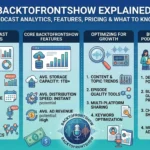
BacktoFrontShow currently presents itself as a podcast analytics service designed to help creators and media teams understand audience activity beyond basic download figures. Its website promotes dashboards and reports that bring together several types of listener and episode information.
| Question | Answer |
|---|---|
| What is BacktoFrontShow? | A website presenting a podcast analytics platform |
| Who may find it relevant? | Podcasters, content creators, media teams, and podcast marketers |
| What features are advertised? | Audience demographics, listening behaviour, engagement, device analytics, geographic insights, and reports |
| Does it list pricing? | Yes. The website displays Basic and Pro monthly plans, plus custom Enterprise pricing |
| Is it a podcast hosting service? | The website primarily presents analytics and audience insights rather than podcast hosting |
| Should users verify the service before paying? | Yes. Confirm access, compatibility, data sources, features, and subscription terms directly with the provider |
The table summarizes the website’s public presentation, not an independent test of its software. Features, availability, and pricing should be confirmed before making a purchase.
1. What Is BacktoFrontShow?
BacktoFrontShow is a name used by a website that describes a podcast analytics platform. According to its current homepage, the service aims to help podcasters and media teams understand their audiences through demographic information, engagement indicators, listening patterns, device data, and geographic insights.
The purpose of this type of software is to turn raw performance figures into information that can inform content planning. For example, a creator may want to know whether a particular episode attracts more attention than previous releases or whether an audience is concentrated in a specific location.
The website also promotes customized reports and an analytics dashboard. These features are intended to bring different measurements together, making it easier to review performance without manually assembling every report.
An important distinction about the name
Search results for BacktoFrontShow can lead to two different identities.
- The current analytics offering: The website describes tools for podcast performance, audience insights, and reporting.
- The earlier podcast: Older pages on the domain identify The Back to Front Show as a web and technology podcast hosted by Keir Whitaker and Kieran Masterton. Its archived episodes discuss web development, design, technology, and the digital industry.
The original episode pages provide evidence of that earlier podcast identity. For example, the first episode archive describes the show and its hosts.
These two uses of the name should not automatically be treated as the same product or operation. Anyone researching BacktoFrontShow should check which website pages and offering they are actually evaluating.
2. How Does BacktoFrontShow Work?
The current website outlines a process that moves from connecting a podcast to collecting information, reviewing analytics, and producing reports. The precise integrations, supported hosting services, and data sources should be confirmed with the provider before relying on the platform.
Step 1: Connect your podcast
The advertised process begins with integrating a podcast into the service. Before proceeding, users should establish which hosting platforms or feeds are supported and whether additional permissions are required.
This matters because analytics tools cannot necessarily access every metric from every publishing platform. Available data depends on the integration and the information supplied by the relevant service.
Step 2: Collect audience information
After integration, the platform says it gathers listener-related data for analysis. Depending on the data source, useful information may include episode performance, listening patterns, device categories, or geographic trends.
Not every podcast platform exposes the same measurements. Therefore, it is worth asking which figures are directly measured, which are estimated, and which depend on third-party integrations.
Step 3: Review the analytics dashboard
The dashboard is intended to make audience and performance information easier to examine. Instead of looking only at total downloads, a creator can use available measurements to investigate which episodes attract interest and how listening activity changes over time.
A dashboard is most valuable when its metrics are clearly defined and easy to compare across equivalent reporting periods.
Step 4: Create reports
BacktoFrontShow advertises customizable reporting. Such reports can help creators review results, share findings with colleagues, and evaluate whether their content strategy is moving in the intended direction.
Before choosing a paid plan, confirm which report formats are available, whether reports can be exported, and whether multiple team members can access them.
3. Key Features of BacktoFrontShow
The website promotes several features intended to help podcast teams understand their audiences. Their practical value depends on the information the service can access and how accurately it presents that information.
Audience demographics
Demographic insights can help creators understand whether their content reaches the people they intend to serve. Depending on the available data, this may include age ranges, locations, or other audience characteristics.
For instance, a business podcast aimed at small-business owners may want to understand whether it is attracting listeners from its intended market. Demographic information can provide useful context, but it should not be interpreted as a complete picture of every listener.
Listening behaviour
Listening behaviour can help creators investigate how audiences interact with individual episodes. The website promotes listening trends and episode-performance analysis.
These insights can support questions such as:
- Which episodes receive the most attention?
- Do particular topics appear to attract more listeners?
- How does performance change after a new release?
- Are listeners returning to previously published content?
The answers can guide future experiments. However, a creator should avoid assuming that one successful episode guarantees the same outcome for every future release.
Engagement monitoring
BacktoFrontShow advertises engagement tracking that includes interactions such as likes, shares, and comments. Such information can help creators understand how audiences respond to content where these measurements are available.
Engagement figures are particularly useful when reviewed alongside other indicators. A high number of interactions may signal interest, but it does not automatically mean that an episode generated sales, subscriptions, or long-term audience loyalty.
Device analytics
Device information can reveal how audiences access podcast content. Understanding device preferences may help creators consider accessibility, playback quality, and the listening experience.
Before relying on this feature, confirm which devices and listening platforms are covered. Data availability may differ between podcast apps and distribution services.
Geographic analytics
Geographic insights can show where an audience is concentrated when location data is available. This information may be useful for creators planning local promotions, regional topics, live events, or market-specific sponsorships.
For example, a podcast with a substantial audience in one city might test a locally relevant episode or consider an event in that area. Geographic information should still be interpreted carefully because location data may be incomplete or approximate.
Custom reports and integrations
The website also promotes customized reports and integrations with external systems, including marketing and customer relationship management tools on its advertised plans.
These capabilities may be helpful for larger teams that combine podcast activity with wider marketing reporting. Prospective customers should ask which integrations are currently available, what setup is required, and whether any additional charges apply.
4. Why Podcast Analytics Matter
Podcast analytics can help creators replace guesswork with a more structured approach to content decisions. However, data becomes useful only when it informs a clear question or action.
Improve future episode planning
Performance data can reveal which topics deserve further exploration. If several episodes about a particular subject consistently attract interest, a creator could test a related series, invite a specialist guest, or answer questions raised by listeners.
It is important to compare episodes fairly. Release timing, promotional activity, episode length, and changes in distribution can all influence results.
Understand audience preferences
Knowing who listens and how they interact with content can help a podcast stay relevant. Audience feedback, geographic patterns, and engagement metrics may reveal opportunities to improve subjects, formats, or publishing schedules.
Still, analytics should complement direct feedback rather than replace it. Comments, surveys, and conversations with listeners can explain motivations that numerical reports cannot show.
Support sponsorship discussions
Advertisers often want evidence that a podcast reaches an audience relevant to their campaign. Reliable performance reports may help creators explain their reach and demonstrate the characteristics of their audience.
However, downloads and engagement alone do not prove that a sponsorship will deliver a specific return. Campaign objectives, audience relevance, conversion tracking, and the sponsor’s offer also matter.
Measure changes over time
A consistent reporting process helps creators assess whether experiments are working. For example, a show might change its episode titles, publishing schedule, promotional channels, or format.
Reviewing results before and after a change can help identify useful patterns. To draw stronger conclusions, creators should allow enough time for data collection and account for other changes that may affect performance.
5. Who Might Benefit From BacktoFrontShow?
The platform’s advertised features may be relevant to several groups. Suitability depends on the user’s needs, budget, current podcast setup, and the actual functionality available after access is granted.
Independent podcasters
Independent creators may want a clearer view of which episodes perform well and where their listeners are located. A separate analytics tool could be useful if the creator’s existing hosting dashboard does not provide enough information.
Nevertheless, beginners should first review the statistics already available through their hosting provider. Paying for additional analytics makes sense only when the extra information supports a meaningful decision.
Podcast marketing teams
Marketing teams may need consistent reporting across content, campaigns, and audience segments. Custom reports and integrations could be useful if they work with the team’s existing tools.
Before adopting the service, check whether it can connect to the platforms the team already uses and whether its metrics match the team’s reporting requirements.
Media companies and podcast networks
Organizations managing multiple shows may need a consolidated view of episode performance and audience activity. They may also require role-based access, consistent reports, and a clear approach to data management.
A larger team should request a demonstration and test its actual workflow before committing to an expensive subscription.
Businesses using podcasts for marketing
Businesses can use podcasts to educate potential customers, build brand awareness, and establish expertise. Analytics may help them understand which topics attract attention and whether their audience aligns with their target market.
Even so, podcast performance should not be confused with business results. Leads, enquiries, purchases, and other outcomes need suitable tracking beyond listening statistics alone.
6. BacktoFrontShow Pricing and Plans
The public pricing page lists three options: Basic, Pro, and Enterprise. The first two display monthly prices, while Enterprise pricing requires contacting the provider.
| Plan | Publicly listed price | What the website indicates |
|---|---|---|
| Basic | $1,200 per month | Analytics, audience information, engagement monitoring, and reporting-related features |
| Pro | $3,600 per month | Basic features plus additional capabilities, including API integration as described on the pricing page |
| Enterprise | Contact provider | A broader feature set with custom pricing |
Important: These are prices displayed on the website, not independently verified quotes or a guarantee of current availability. Confirm the currency, billing terms, taxes, access conditions, included usage, and cancellation policy directly with the provider.
The listed prices are substantial for an independent creator. Before paying, compare the proposed cost with your podcast’s budget, current analytics options, and the value of the additional insights.
Is there a free plan?
The public pricing page highlights paid plans and an Enterprise option. It does not clearly establish a permanent free plan. Contact the provider to ask whether a trial, demonstration, or lower-cost entry option is available.
Is the Pro plan worth the extra cost?
That depends on the features you actually need. A larger plan may be appropriate for an organization that requires additional integrations or reporting capabilities, but the higher price alone does not demonstrate better results.
Ask for a feature-by-feature comparison and a demonstration using a representative workflow. The decision should be based on measurable value, not just the number of features advertised.
7. Potential Benefits and Limitations
A balanced assessment should consider both the potential value of the advertised features and the questions that remain unanswered.
Potential benefits
- Broader reporting: Combining several types of analytics may offer more context than a single download figure.
- Audience insights: Demographic and geographic information can support content planning when the underlying data is reliable.
- Performance comparisons: Episode-level reporting may help creators assess changes over time.
- Customized reports: Tailored reporting can be useful for teams with specific internal or client requirements.
- Marketing workflows: Integrations may help organizations connect podcast information with other reporting systems, if the required connections are supported.
Limitations and questions to resolve
- Data access: The value of the platform depends on the sources and metrics it can access.
- Independent validation: Public feature descriptions do not establish how accurately the platform measures every advertised metric.
- Cost: The displayed Basic and Pro prices may be difficult to justify for creators with modest audiences or limited budgets.
- Integration requirements: Compatibility, setup effort, and additional charges should be confirmed in advance.
- Privacy and security: Users should review the provider’s data-handling practices and the permissions required to connect their accounts.
These are practical evaluation points, not claims that the service fails to deliver its advertised features. A demonstration and written answers from the provider can help prospective customers make a better-informed decision.
8. What to Check Before Signing Up
Before purchasing any podcast analytics service, work through the following checklist.
Confirm the exact service
Make sure you are reviewing the current analytics offering rather than older podcast archives or unrelated websites using a similar name. Check the official domain, contact details, and the terms associated with the offer.
Ask for a live demonstration
A demonstration should show how the platform connects to a podcast, what data appears in the dashboard, and how a report is produced. Ask the representative to explain any metric that is unclear.
Verify supported platforms
Find out whether the service supports your podcast host, distribution platforms, and reporting workflow. Confirm which metrics are available for your particular setup rather than relying on a general feature list.
Check the data definitions
Ask how downloads, listening time, engagement, demographics, and location are defined. You should understand whether a figure is measured directly, supplied by another platform, estimated, or unavailable in certain cases.
Review privacy and security
Understand what information the service collects, how it is stored, who can access it, and how account connections can be revoked. If you manage a company or client podcast, check the relevant data-protection obligations before connecting accounts.
Calculate the total cost
Confirm the billing currency, contract length, renewal terms, taxes, onboarding fees, and any charges for extra users or integrations. Request the full terms in writing before sharing payment information.
Compare alternatives
Review the analytics supplied by your podcast host and distribution services first. If those tools already answer your key questions, a separate subscription may not be necessary.
9. BacktoFrontShow vs Basic Podcast Statistics
The difference between basic podcast statistics and a dedicated analytics tool generally comes down to the depth of reporting and the questions a creator needs to answer.
| Area | Basic statistics | More detailed analytics |
|---|---|---|
| Episode performance | Often emphasizes downloads or plays | May provide additional comparisons and trends |
| Audience information | Depends on the provider | May include more demographic or geographic detail |
| Engagement | May be limited to available platform metrics | May combine supported interaction indicators |
| Reporting | Standard dashboards or exports | May offer customizable reports |
| Integrations | Depends on the hosting or distribution service | May connect with additional marketing or reporting systems |
| Cost | May be included with existing services | May require a separate subscription |
This is a general comparison, not a verified feature-by-feature test of BacktoFrontShow against a named competitor. Actual capabilities vary by provider and subscription.
A creator should start with the questions they need answered. If download totals and episode trends are sufficient, basic analytics may be enough. More advanced reporting becomes useful when it provides reliable information that changes a content, marketing, or business decision.
10. How to Choose a Podcast Analytics Tool
BacktoFrontShow is one option to investigate, but the right tool depends on your podcast’s size and goals. Use the following process to compare options.
First, define your objective. Decide whether you need to improve episode planning, understand audience locations, prepare sponsor reports, or connect podcast data with wider marketing results.
Next, identify missing information. Review the analytics you already receive. Write down the questions those reports cannot answer so you can evaluate whether a new tool fills a real gap.
Then, verify compatibility. Confirm that the service supports your podcast host and the platforms through which your audience listens. Check the limitations of each integration.
After that, compare the cost with the value. Estimate how the additional insights could improve your workflow or decisions. Avoid assuming that more detailed dashboards automatically create audience growth.
Finally, test before committing. Request a demonstration, review the terms, and make sure the reporting is clear enough for your team to use consistently.
The best analytics tool is not necessarily the one with the longest feature list. It is the one that supplies dependable information for the decisions you actually need to make.
Final Thoughts
BacktoFrontShow is a name that requires a little context because its online presence includes both a current podcast analytics offering and material associated with an earlier web-industry podcast. Its present website promotes audience demographics, listening behaviour, engagement monitoring, geographic insights, device analytics, and customizable reporting.
Those features may be useful to creators and media teams that need more detailed performance information. Still, a feature list alone cannot establish accuracy, compatibility, or value for money. The publicly listed Basic and Pro plans are expensive enough that careful evaluation is essential.
Before choosing BacktoFrontShow, identify the questions you need answered, compare its capabilities with your existing analytics, and confirm all pricing and service details directly with the provider. A tool is worth paying for when its reliable insights support better decisions—not simply because it offers more charts and reports.
What is BacktoFrontShow used for?
BacktoFrontShow’s current website presents it as a podcast analytics platform. Its advertised features cover audience demographics, listening behaviour, engagement, device usage, geographic insights, and customizable reports.
Is BacktoFrontShow a podcast hosting platform?
The current website emphasizes analytics and audience insights rather than podcast hosting. Check directly with the provider whether it offers hosting or distribution capabilities before assuming those services are included.
How much does BacktoFrontShow cost?
The public pricing page lists Basic at $1,200 per month, Pro at $3,600 per month, and Enterprise with custom pricing. These details should be confirmed with the provider before purchase.
Who may benefit from BacktoFrontShow?
Podcasters, marketing teams, media organizations, and businesses using podcasts may find the advertised analytics relevant. Whether it is suitable depends on their data requirements, budget, integrations, and available alternatives.
Is BacktoFrontShow worth paying for?
It may be worth considering if its verified features answer questions that your current analytics cannot. However, the listed monthly prices are substantial, so prospective users should request a demonstration, confirm the included functionality, and compare alternatives before subscribing.